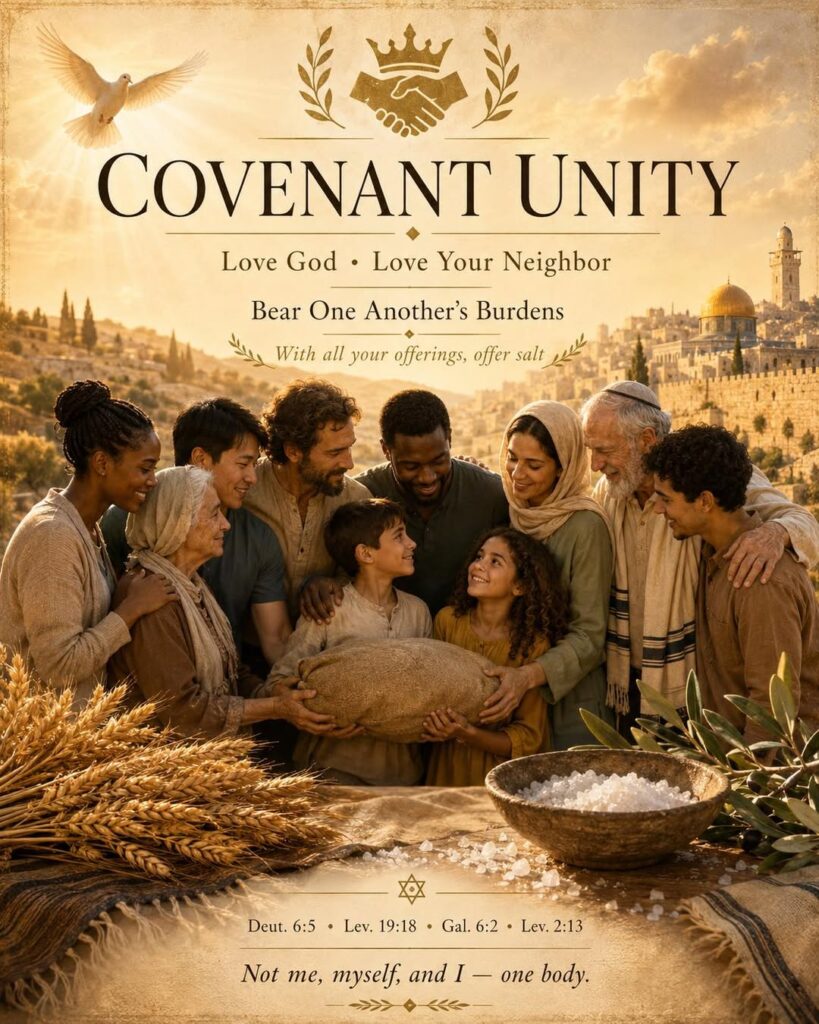
Unity, Burden-Bearing, and the Covenant of Salt
1. We Were Not Built for “Me, Myself, and I”
Biblical faith does not begin with isolated individualism. It begins with covenant.
Genesis 2:18 says, “It is not good that the man should be alone.” From the beginning, God made humanity for relationship: with Him, with one another, with family, with community, with covenant responsibility.
The foundation is the Shema:
Deuteronomy 6:4–5 — “Hear, O Israel: The LORD our God, the LORD is one. You shall love the LORD your God with all your heart and with all your soul and with all your strength.”
But love for God cannot stay private. The Torah also commands:
Leviticus 19:18 — “You shall love your neighbor as yourself.”
Yeshua ties these together:
Matthew 22:37–40 — love God with all your heart, soul, and mind, and love your neighbor as yourself. On these two commandments hang all the Law and the Prophets.
So the Kingdom is not built on “me, myself, and I.” It is built on love for God that becomes visible in love for people.
1 John 4:20 says we cannot claim to love God while hating our brother.
John 13:34–35 says the world will know Yeshua’s disciples by their love for one another.
Unity is not optional. It is evidence.
2. The Covenant of Salt
Leviticus 2:13–14 says:
“You shall season all your grain offerings with salt. You shall not let the salt of the covenant with your God be missing from your grain offering; with all your offerings you shall offer salt.”
This is the key phrase:
Do not let the salt of the covenant be missing.
Salt in Scripture speaks of preservation, faithfulness, purification, flavor, and covenant loyalty.
The Bible also speaks of a covenant of salt in:
Numbers 18:19 — priestly provision is called an everlasting covenant of salt.
2 Chronicles 13:5 — the kingdom was given to David by a covenant of salt.
So salt touches worship, priesthood, and kingdom authority.
This means God cares not only that we bring an offering, but what spirit we bring it in.
A ministry can have activity but no salt.
A team can have meetings but no covenant.
A volunteer base can have energy but no unity.
A leader can have vision but no love.
A person can bring grain but forget the salt.
And the Lord says: with all your offerings, offer salt.
3. Salt Means Covenant Loyalty Between People
In the ancient world, salt was connected with hospitality, loyalty, and friendship. When people shared bread and salt, they were no longer simply strangers. A bond had been formed.
That picture matters.
Two travelers can meet as strangers. They may come from different tribes, nations, languages, histories, or wounds. But when they share covenant hospitality, they enter a different relationship. They now owe one another peace, protection, and honor.
This is what we need among us.
There may be ethnic differences.
There may be national differences.
There may be theological differences.
There may be cultural differences.
There may be differences among volunteers.
There may be differences among the factions of Israel.
But the covenant must be stronger than the difference.
Mark 9:50 says, “Have salt in yourselves, and be at peace with one another.”
Salt and peace belong together.
4. Unity Does Not Mean Sameness
Biblical unity is not everyone becoming the same.
Israel had twelve tribes.
The body has many members.
The Kingdom includes many nations.
The Spirit gives many gifts.
Psalm 133:1 — “How good and pleasant it is when brothers dwell in unity.”
1 Corinthians 12:12–27 — many members, one body. The eye cannot say to the hand, “I have no need of you.”
Ephesians 4:1–6 — walk with humility, gentleness, patience, bearing with one another in love, eager to maintain the unity of the Spirit in the bond of peace.
Colossians 3:12–15 — put on compassion, kindness, humility, meekness, patience, forgiveness, and above all love.
Unity is not pretending differences do not exist. Unity is refusing to let differences become division.
5. Bearing One Another’s Burdens
Galatians 6:2 says:
“Bear one another’s burdens, and so fulfill the law of Messiah.”
This is one of the clearest definitions of covenant community.
The strong carry the weak.
The encouraged strengthen the discouraged.
The stable help the shaken.
The healed help the wounded.
The mature restore the fallen gently.
Romans 15:1 — the strong must bear with the weaknesses of the weak.
1 Thessalonians 5:14 — encourage the fainthearted, help the weak, be patient with all.
James 2:14–17 — faith without practical care is dead.
1 John 3:16–18 — love not only in word, but in deed and truth.
A covenant community does not say, “That is your problem.”
It says, “Your burden is now inside our field of love.”
6. Shavuot: Shared Joy, Shared Harvest, Shared Community
Shavuot is not only about private blessing. It is about shared harvest, shared worship, and shared joy.
Leviticus 23:15–21 commands Israel to count seven complete weeks, bring the firstfruits, present the offering, and gather in holy assembly. The passage moves from firstfruits, to counting, to the fiftieth day, to a new grain offering before the Lord.
Deuteronomy 16:10–11 says to celebrate Shavuot with a freewill offering according to how God has blessed you, and to rejoice before the Lord with your son, daughter, servants, Levites, strangers, orphans, and widows.
That means biblical joy is not selfish joy.
It is not:
“I got blessed.”
“I got filled.”
“I got my harvest.”
It is:
“Bring the family.”
“Bring the stranger.”
“Bring the orphan.”
“Bring the widow.”
“Bring the whole community before the Lord.”
Romans 14:17 says the Kingdom of God is righteousness, peace, and joy in the Holy Spirit.
Kingdom joy crosses language, culture, nationality, and background. It becomes an invitation: come and see that the Lord is good.
7. Pentecost: The Spirit Creates One Body
In Acts 2, the believers are gathered together at Pentecost, the fiftieth day connected to Shavuot.
Acts 2:1 — “They were all together in one place.”
Then the Spirit comes.
There is wind.
There is fire.
There is filling.
There is speech.
There is witness to the nations.
At Babel, language scattered people.
At Pentecost, the Spirit begins healing division through holy witness.
The nations are not erased. Different languages are still present. But now the mighty works of God are being heard across those languages.
The Spirit does not create isolated religious consumers. He creates one body.
1 Corinthians 12:13 — by one Spirit we were baptized into one body.
Ephesians 4:3–4 — maintain the unity of the Spirit; there is one body and one Spirit.
Romans 5:5 — God’s love is poured into our hearts through the Holy Spirit.
Galatians 5:22–23 — the fruit of the Spirit is love, joy, peace, patience, kindness, goodness, faithfulness, gentleness, and self-control.
That is what salted people should taste like.
8. Yeshua’s Prayer for Unity
Before the cross, Yeshua prayed:
John 17:21 — “That they may all be one.”
And He says this unity will show the world that the Father sent Him.
So unity is missional.
Disunity damages witness.
Love reveals Messiah.
Covenant unity becomes a sign to the world.
This does not mean fake unity. It does not mean ignoring sin. It means holy unity — truth and love together.
Ephesians 4:15 says to speak the truth in love.
Truth without love becomes a weapon.
Love without truth becomes weakness.
Salted speech carries both.
9. Witnesses from Jewish Tradition and History
The Apocrypha and Jewish tradition also carry this theme.
Sirach 6:14–17 says a faithful friend is a strong shelter and life-giving medicine. That is covenant friendship.
Tobit 4 emphasizes mercy, generosity, honoring family, and caring for the poor.
Pirkei Avot 1:12 says to be like the disciples of Aaron: loving peace, pursuing peace, loving people, and drawing them near to Torah.
That phrase matters: pursuing peace.
Peace does not happen by accident. Covenant people chase it. They repair what is broken. They refuse gossip, bitterness, and factionalism.
The Dead Sea Scrolls and Second Temple communities also show that Jewish faith was not merely private spirituality. It was communal, ordered, disciplined, and covenantal. Holy people were expected to live together in holiness.
10. Practical Charge for the Team
This message is especially important for a volunteer community and for Israel.
We cannot afford ethnic division.
We cannot afford theological arrogance.
We cannot afford national suspicion.
We cannot afford volunteer cliques.
We cannot afford gossip.
We cannot afford “me, myself, and I” ministry.
The hour is too serious.
The mission is too holy.
The offering must have salt.
So we must ask:
Is our work salted with love?
Is our correction salted with humility?
Is our speech salted with grace?
Is our leadership salted with service?
Is our theology salted with mercy?
Is our joy shared with the stranger, orphan, widow, and weak?
Are we carrying one another’s burdens?
Colossians 4:6 says our speech should be gracious, seasoned with salt.
So let our words preserve life, not poison it.
11. Final Call
The Bible never gives us a “me, myself, and I” faith.
God says: love Me with all your heart.
God says: love your neighbor as yourself.
Yeshua says: love one another as I have loved you.
Paul says: bear one another’s burdens.
Leviticus says: do not let the salt of the covenant be missing.
So with all our offerings, we must offer salt.
Salt in our worship.
Salt in our speech.
Salt in our teamwork.
Salt in our leadership.
Salt in our correction.
Salt in our hospitality.
Salt in our love for Israel.
Salt in our care for volunteers.
Salt in our service to the wounded, the stranger, the orphan, and the widow.
Lord, make us a salted people.
Not shallow peace, but covenant peace.
Not fake unity, but costly love.
Not sameness, but one body.
Not isolation, but family.
Not “me, myself, and I,” but one people before one King.
With all your offerings, offer salt.