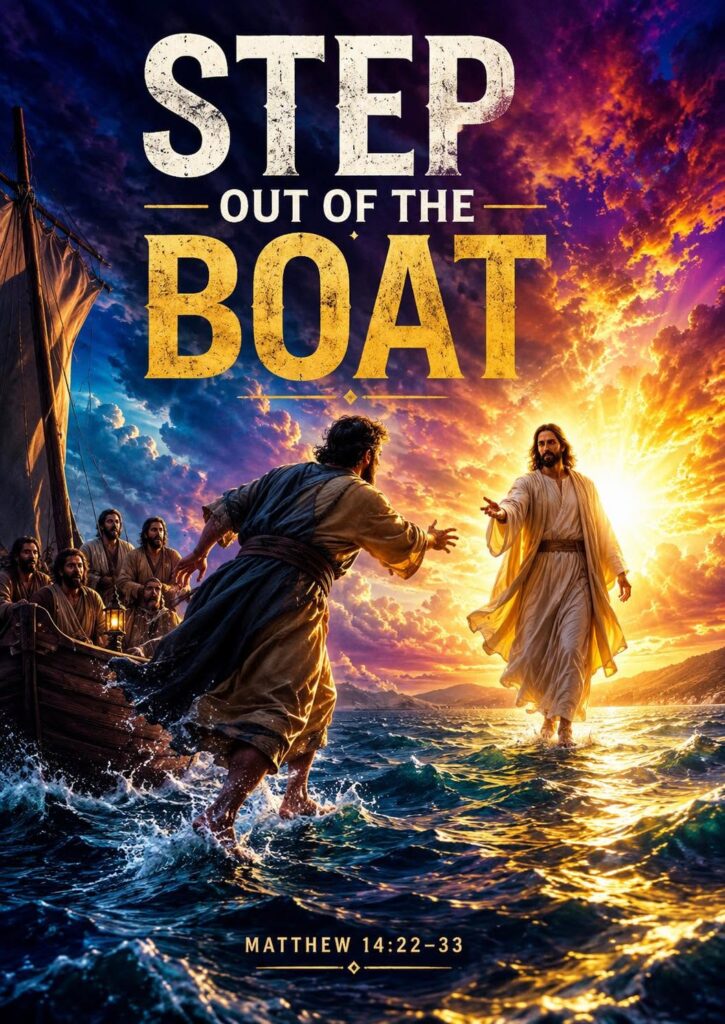
STEP OUT OF THE BOAT: LEAVING THE COMFORT ZONE FOR DESTINY
Scripture foundation: Matthew / מתי 14:22–33
Faith is not just believing from the boat. Faith is stepping when Yeshua says, “Come.”
In Matthew / מתי 14:22–33, Yeshua sends His disciples into a boat and tells them to go ahead to the other side. Then He sends the crowds away and goes up the mountain alone to pray. From a mountain like Mount Arbel, looking over the Sea of Galilee, the Kinneret, the water can look peaceful, beautiful, and calm. From the viewpoint, the lake looks like a painting. But down in the boat, the disciples were not seeing a calm picture. They were wet. They were tired. The wind was against them. The waves were hitting the boat. They were not in a faith mood.
That is important.
Sometimes we think faith only happens when we feel spiritual, peaceful, rested, and ready. But this story shows us that Yeshua often comes when we are exhausted, uncomfortable, afraid, and just trying to make it through the night.
Matthew / מתי 14:26–27 says that when the disciples saw Him walking on the sea, they were troubled and cried out in fear. They did not recognize Him at first. Fear made them misread the miracle. The One coming toward them was not destruction. It was Yeshua.
Then He spoke: “Be of good cheer; it is I; be not afraid.”
Before Peter ever steps out of the boat, Yeshua speaks. His voice enters the storm. The wind is real. The waves are real. The exhaustion is real. The fear is real. But His voice is greater than the storm.
Fear asks, “What is happening?” Faith asks, “Who is speaking?”
Then Peter answers Him and says, “Lord, if it is You, command me to come to You on the water.” Yeshua answers with one word: “Come.” Matthew / מתי 14:28–29.
That one word changed everything.
The boat represents safety, control, and the familiar. The water represents risk, uncertainty, and impossibility. The boat was not evil. The boat had carried them. The boat had protected them. The boat was useful. But when Yeshua said, “Come,” the place of safety became the place Peter had to leave.
That is where the comfort zone is exposed.
A resort can be a place of comfort. Rest can be a gift. Rest can be holy. Rest can restore you. But a comfort zone is different. A resort is where you rest. A comfort zone is where you refuse to move. A resort can refresh you, but a comfort zone can restrain you.
The question is not, “Is comfort always wrong?” The question is, “Has comfort become stronger in my life than obedience?”
The first time you drove, you had to leave your comfort zone. The car felt scary because you were not fully in control yet. A job interview can push you out of your comfort zone because you are being tested, questioned, and stretched. Studies can stretch you because you are learning things you do not yet understand. Army service can take you out of comfort and teach discipline, courage, and responsibility. Aliyah means leaving what is familiar and stepping into promise, identity, covenant, and calling.
These are pictures of faith.
Growth often begins where comfort ends.
So what are our comfort zones?
For some, the comfort zone is control. We want every detail figured out before we obey. For others, it is fear of failure. We do not want to look foolish. We do not want to sink. We do not want people to laugh. For others, it is people’s approval. Proverbs / משלי 29:25 says, “The fear of man brings a snare, but whoever trusts in Adonai shall be safe.”
The fear of man keeps us in the boat, but trust in Elohim calls us onto the water.
For some, the comfort zone is money. For others, it is security, reputation, routine, old identity, family expectations, cultural pressure, or spiritual passivity. Spiritual passivity says, “I believe,” but it does not move when Yeshua says, “Come.”
The boat is not always sin. Sometimes the boat is simply the place where faith stops moving.
Peter stepped out. He did not have perfect faith. He did not have fearless faith. But he had enough faith to obey the voice of Yeshua. Taking a step of faith is faith. Faith becomes real when it moves.
And scientifically, this moment is impossible.
A human body has a density close to water. Water is about 1.00 g/cm³. The human body averages around 0.985 to 1.05 g/cm³ depending on muscle, fat, bone, and air in the lungs. That is why a human can sometimes float when lying down and displacing enough water. But Peter was not floating. He was standing. He was walking.
Water molecules are not locked together like solid ground. They move. They separate. A human foot places weight on a small surface area. Gravity pulls downward. Surface tension is far too weak to hold a grown man. Buoyancy can help a body float when it displaces enough water, but it cannot make a standing man walk weightlessly on the surface.
Naturally speaking, Peter should have gone down.
Matter says sink. Molecules say impossible. Gravity says down. But Yeshua says, “Come.”
If we try to imagine it scientifically, the water beneath Peter’s feet would have needed to behave differently from normal water. It would need some kind of localized support, almost as if the Creator commanded the H₂O molecules under Peter’s feet to resist separation for that moment.
It would be like a localized non-Newtonian effect. A non-Newtonian fluid can behave differently under pressure. For example, oobleck, made from cornstarch and water, can feel liquid when touched gently but become firm when struck with force. Normal water does not naturally act that way. But if Yeshua commanded the water to hold Peter, then the water obeyed the voice of its Creator.
Another way to imagine it is like a force-field effect. A force field would not need to make Peter weightless. It would simply need to create upward support beneath his feet, like an invisible platform. In physics, the upward force would have to equal or exceed Peter’s downward weight. If gravity is pulling Peter down, something must hold him up.
A pressure-field effect would be another picture, like a hovercraft cushion holding weight above a surface. A molecular-locking effect would be another picture, where the water molecules beneath his feet are held together just long enough for each step. An anti-gravity effect would be another picture, where gravity’s pull on Peter is reduced so the water would not need to hold as much weight.
But the point is not that Yeshua needed a force field, anti-gravity technology, or a hidden scientific trick.
The point is greater than that.
Yeshua is Lord over gravity.
Yeshua is Lord over density.
Yeshua is Lord over pressure.
Yeshua is Lord over matter.
Yeshua is Lord over the molecules.
Yeshua is Lord over creation itself.
The hydrogen and oxygen molecules did not decide to hold Peter. Creation recognized its King.
The water did not become powerful. The water became obedient.
Peter was not held up by water. Peter was held up by the Word.
Faith does not deny science. Faith recognizes that Elohim is greater than the system He created. Science explains why Peter should sink. The Word explains why Peter could walk.
Gravity still said down.
Fear still said stay.
The storm still said impossible.
But Yeshua said, “Come.”
Then fear enters.
Matthew / מתי 14:30 says that when Peter saw the wind, he was afraid, and beginning to sink, he cried out, “Lord, save me.”
Notice this carefully: Peter was already walking. The miracle had already begun. He had already left the boat. He had already experienced the impossible. But fear can enter even after faith starts moving.
Fear entered when focus shifted.
Peter did not begin to sink because the storm became stronger than Yeshua. He began to sink because his eyes moved from Yeshua to the storm. The wind was real. The waves were real. The danger was real. But fear became louder than the voice that said, “Come.”
This is what fear does. Fear makes you question the step Elohim already called you to take. Fear makes you forget that the same Yeshua who called you out is still standing in front of you.
But Peter cried, “Lord, save me,” and immediately Yeshua stretched out His hand and caught him.
Immediately.
Not after a lecture. Not after Peter proved himself. Not after Peter swam halfway back. Yeshua caught him.
Your first steps of faith may be shaky. A baby does not walk perfectly the first time. The first steps are unbalanced, uncertain, and weak. But the parent is watching, arms open, ready to catch. That is Peter on the water. His faith was real, but it was still growing. He stepped, he feared, he sank, and Yeshua caught him.
First steps of faith may be shaky, but Yeshua still honors the step.
This brings us to surrender.
Surrender to Adonai is hard because the flesh wants control. We want comfort. We want safety. We want the boat. We want the familiar. But Yeshua says, “Come.”
Surrender means saying, “I trust Your voice more than my fear. I trust Your will more than my plan. I trust You more than I trust my comfort.”
Matthew / מתי 16:24–25 says that whoever wants to follow Yeshua must deny himself, take up his cross, and follow Him. Whoever wants to save his life will lose it, but whoever loses his life for Yeshua’s sake will find it. Luke / לוקס 17:33 says the same thing: whoever seeks to preserve his life will lose it, and whoever loses it will preserve it.
Comfort zone says, “Save yourself.”
Faith says, “Step toward Yeshua.”
This is also where we must deal honestly with areas of life where the culture says, “Stay comfortable,” but Scripture says, “Surrender.”
The issue is not only fear, money, reputation, career, or calling. It is also desire. It is also sexuality. It is also identity. The deep question becomes: Am I the center, or is Elohim?
Leviticus / ויקרא 18:22 says that a man shall not lie with a male as with a woman, and it calls this an abomination. Leviticus / ויקרא 20:13 repeats the same Torah boundary regarding male same-sex relations. Genesis / בראשית 19:1–11 is often discussed in connection with Sodom, though the passage also includes violence, abuse of strangers, and sexual corruption. Romans / רומים 1:26–27 speaks of men and women exchanging natural relations and presents disordered desire as part of humanity’s rebellion against Elohim. 1 Corinthians / קורינתים א׳ 6:9–10 warns that unrighteous living does not inherit the Kingdom of Elohim, including sexual sin. 1 Timothy / טימותיאוס א׳ 1:9–10 also lists sexual immorality among practices contrary to sound teaching.
These passages should not make believers proud, cruel, mocking, or hateful. They should make us sober. Every person needs mercy. Every person needs repentance. Every person has desires that must bow before Yeshua. The message is not, “Those people need surrender, but I do not.” The message is, “All of me must surrender to Elohim.”
The modern world often says, “My desire is my identity.” Scripture says, “Your life belongs to Elohim.” The world says, “Be true to yourself.” Yeshua says, “Deny yourself, take up your cross, and follow Me.”
That is not easy.
Surrender is hard.
But the life we try to save outside of obedience is the life we begin to lose. The life we surrender to Yeshua is the life He preserves.
This pattern is everywhere in Scripture.
In 2 Samuel / שמואל ב׳ 11:1, David stayed in Jerusalem at the time when kings went out to battle. David was supposed to be where kings belonged: in the battle. But he stayed behind in comfort. His fall did not begin with Bathsheba. It began when he stayed in comfort instead of going to battle. Comfort becomes dangerous when it keeps you from your assignment.
In Jonah / יונה 1:1–3, Elohim said, “Go to Nineveh,” but Jonah went toward Tarshish. Jonah’s storm began when he chose comfort over calling.
In Numbers / במדבר 13–14, Israel saw the giants and refused to enter the Promised Land. Fear made Egypt look safer than promise. The wilderness was not their destiny; it became their delay because fear sounded safer than faith.
In Genesis / בראשית 13:10–13, Lot chose the well-watered plain near Sodom. It looked good. It looked comfortable. But not every comfortable place is a safe place.
In Judges / שופטים 16, Samson became comfortable with compromise until his strength was cut away. He did not lose his strength in one moment. He lost it by playing near temptation.
In Luke / לוקס 22:54–62, Peter warmed himself by the wrong fire and denied Yeshua. He did not deny Yeshua on the water. He denied Him by the fire, when comfort replaced courage.
In Matthew / מתי 26:40–45, the disciples slept in Gethsemane when Yeshua asked them to watch and pray. Sometimes the battle is not lost because people are wicked, but because they are tired and spiritually asleep.
In Mark / מרקוס 10:17–22, the rich young ruler wanted eternal life, but he could not release the life he had built. Surrender touched the thing he loved most.
In Revelation / התגלות 3:15–17, Laodicea became lukewarm. They were comfortable, wealthy, and self-satisfied, but spiritually blind. Comfort can make you think you need nothing, even when your soul is poor.
So we must ask honestly: What is my boat?
Is it fear?
Is it approval?
Is it money?
Is it sexuality?
Is it reputation?
Is it routine?
Is it control?
Is it comfort?
Is it the opinions of people?
Is it the life I am trying to save?
Every heroic story begins when someone leaves safety and steps into Kingdom purpose, even if that means risk.
David could have missed Goliath.
Esther could have been rejected by the king.
Abraham could have stayed in the familiar.
Moses could have remained in the wilderness.
Peter could have sunk.
There is no heroic faith without the possibility of failure.
Are you willing to risk failure? Are you willing to step even if your knees shake? Are you willing to obey even when you are wet, tired, afraid, and not in a faith mood?
Peter risked sinking, but he also became the disciple who walked on water. The boat was safe, but the miracle was outside the boat.
Faith is not pretending there is no storm. Faith is fixing your eyes on Yeshua in the middle of it. Faith is not waiting until you feel spiritual. Faith may begin when you are exhausted, uncomfortable, and afraid, but you still hear His voice.
The Sea of Galilee may look calm from Mount Arbel, but faith is not learned from the viewpoint. Faith is learned when the wind is against you, the waves are hitting you, and Yeshua says, “Come.”
So step out of the boat.
Not because the water can hold you.
Not because science makes it possible.
Not because fear is gone.
Not because everyone understands.
Not because the risk is small.
Step because Yeshua is there.
Gravity may say down.
Fear may say stay.
Comfort may say wait.
Culture may say self.
People may say impossible.
But Yeshua says, “Come.”
And when He says come, the safest place is not the boat.
The safest place is wherever His voice is calling you33