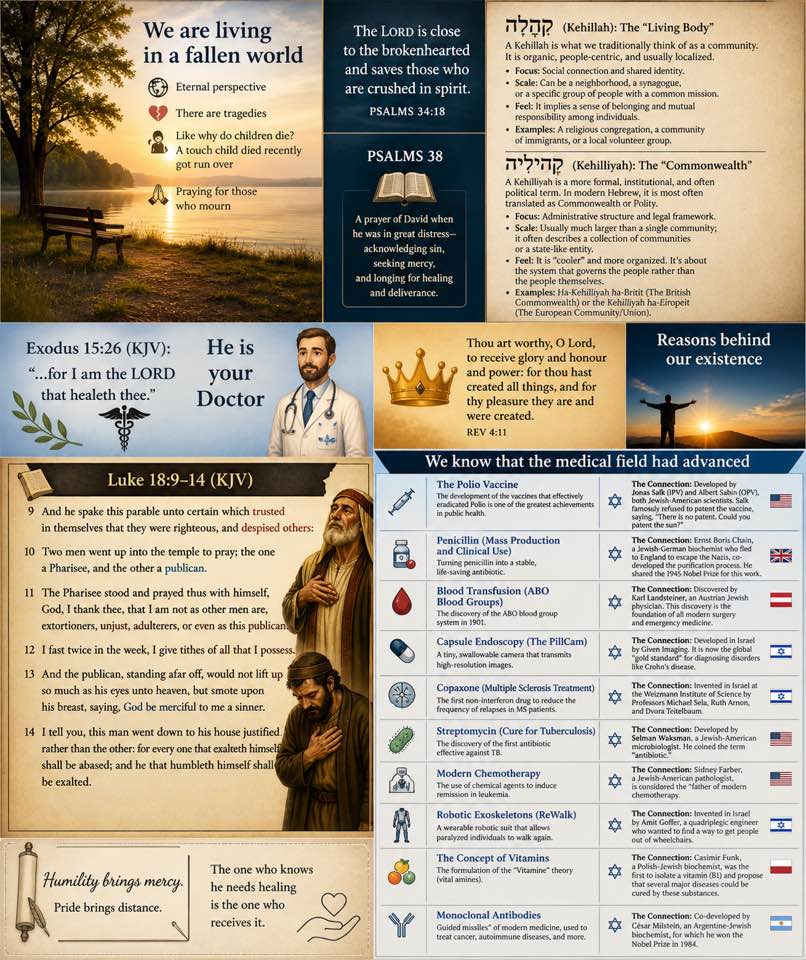
From the Torah, Elohim reveals His nature:
“…for I am the LORD that healeth thee.”
כִּי אֲנִי יְהוָה רֹפְאֶךָ
(Exodus 15:26 / שמות ט״ו:כ״ו)
This is not just a statement—it is a name: YHWH Rapha, the One who heals.
Healing is not an afterthought in Scripture. It is central to the character of Elohim.
And yet, humanity has also pursued healing through wisdom, discovery, and science. Medical breakthroughs—vaccines, antibiotics, blood transfusion systems—have saved millions of lives. These advancements reflect something important:
Human beings are created with the capacity to participate in healing.
As Revelation declares:
“Thou art worthy, O Lord… for thou hast created all things.”
כִּי אַתָּה בָּרָאתָ אֶת־כָּל־הַדְּבָרִים
(Revelation 4:11 / חזון יוחנן ד׳:י״א)
Even scientific progress ultimately reflects the creative order of Elohim.
But medicine, while powerful, cannot heal everything. It cannot remove guilt. It cannot restore the soul. It cannot conquer death.
For that, we need something more.
The Messiah as Physician
Yeshua the Messiah enters this world not merely as a teacher, but as a healer.
He declares:
“They that are whole need not a physician; but they that are sick.”
(Luke 5:31)
In Hebrew concept:
לֹא הַבְּרִיאִים צְרִיכִים לְרוֹפֵא, אֶלָּא הַחוֹלִים
He identifies Himself as a physician of the soul.
But this statement carries a deeper implication:
Only those who recognize they are sick will seek healing.
The Parable of Humility and Mercy
In Luke 18, Yeshua tells a parable:
“God be merciful to me a sinner.”
(Luke 18:13)
Greek:
ἱλάσθητί μοι (hilastheti moi)
Meaning: be atoning toward me
Hebrew concept:
חָנֵּנִי אֱלֹהִים — “Be gracious to me, Elohim”
This is not a casual request. It is a cry for atonement—for covering.
The tax collector stands in humility, while the Pharisee trusts in his own righteousness.
Yeshua concludes:
“This man went down to his house justified…”
(Luke 18:14)
The message is clear:
Healing begins with humility.
Bondage and the Need for Healing
Humanity is not just sick—it is bound.
Scripture describes multiple layers of bondage:
Inner Bondage
Pride
Fear
Shame
Unbelief
Behavioral Bondage
Addiction
Greed
Violence (גזל)
Immorality
Spiritual Bondage
Deception
Idolatry
Oppression
Existential Bondage
Death
Separation from Elohim
As Isaiah prophesied:
“To proclaim liberty to the captives… and the opening of the prison.”
לִקְרוֹא לִשְׁבוּיִים דְּרוֹר וְלַאֲסוּרִים פְּקַח־קוֹחַ
(Isaiah 61:1 / ישעיהו ס״א:א׳)
The Messiah comes not just to comfort—but to liberate.
The Samaritan Woman — A Picture of Freedom
In John 4, we see healing unfold step by step.
The woman at the well is:
isolated
ashamed
spiritually confused
Yeshua meets her where she is.
“Come, see a man…”
(John 4:29)
Her journey includes:
freedom from isolation
freedom from shame
freedom from misunderstanding
freedom into purpose
She becomes a witness.
Healing leads to transformation—and transformation leads to mission.
Faith and Works — The Right Order
Paul clarifies in Galatians:
“Having begun in the Spirit, are you now made perfect by the flesh?”
(Galatians 3:3)
The issue is not whether works are good—they are.
“He hath shewed thee… what is good.”
הִגִּיד לְךָ אָדָם מַה־טּוֹב
(Micah 6:8 / מיכה ו׳:ח׳)
But works cannot heal the soul.
They are the fruit—not the root.
Healing comes first. Transformation follows.
Yeshua and the Broken
Yeshua consistently moves toward the broken:
lepers
blind
sinners
outcasts
He fulfills Isaiah:
“He hath sent me to bind up the brokenhearted.”
(Isaiah 61:1)
He heals:
blindness
paralysis
disease
demonic oppression
But more importantly, He heals identity.
The Invitation to Rest
Yeshua calls out:
“Come unto me, all ye that labour and are heavy laden…”
(Matthew 11:28)
Hebrew idea:
בֹּאוּ אֵלַי כָּל־הַיְּגֵעִים וְהָעֲמוּסִים
He offers:
rest
peace
relief
“For my yoke is easy, and my burden is light.”
(Matthew 11:30)
This is not the removal of responsibility—it is the removal of crushing weight.
The Deeper Problem — Self-Reliance
Humanity often says:
“Physician, heal yourself.”
(Luke 4:23)
This reflects a deeper issue:
self-reliance
demand for proof
resistance to surrender
But the Kingdom operates differently.
Healing comes not through control—but through trust.
The Pattern of the Messiah
Throughout Scripture, we see a consistent pattern:
Encounter
Exposure
Humility
Healing
Transformation
Purpose
This is the path from bondage to freedom.
Why We Need a Healer
We have:
knowledge
medicine
systems
But we still face:
death
guilt
brokenness
We need more than improvement.
We need restoration.
We need more than answers.
We need a healer.
Conclusion — The Call to Come
The message of the Messiah is simple, but profound:
Come.
Come with:
your pain
your questions
your failure
Come not as the righteous—but as the sick.
Like the tax collector:
“Be merciful to me…”
Like the brokenhearted:
trusting that Elohim is near.
Because in the end:
We do not heal ourselves.
We do not save ourselves.
We come to the One who says:
“I am the LORD your healer.”
(Exodus 15:26)
 Final truth
We need a hero.
We need a healer.
We need the Messiah.