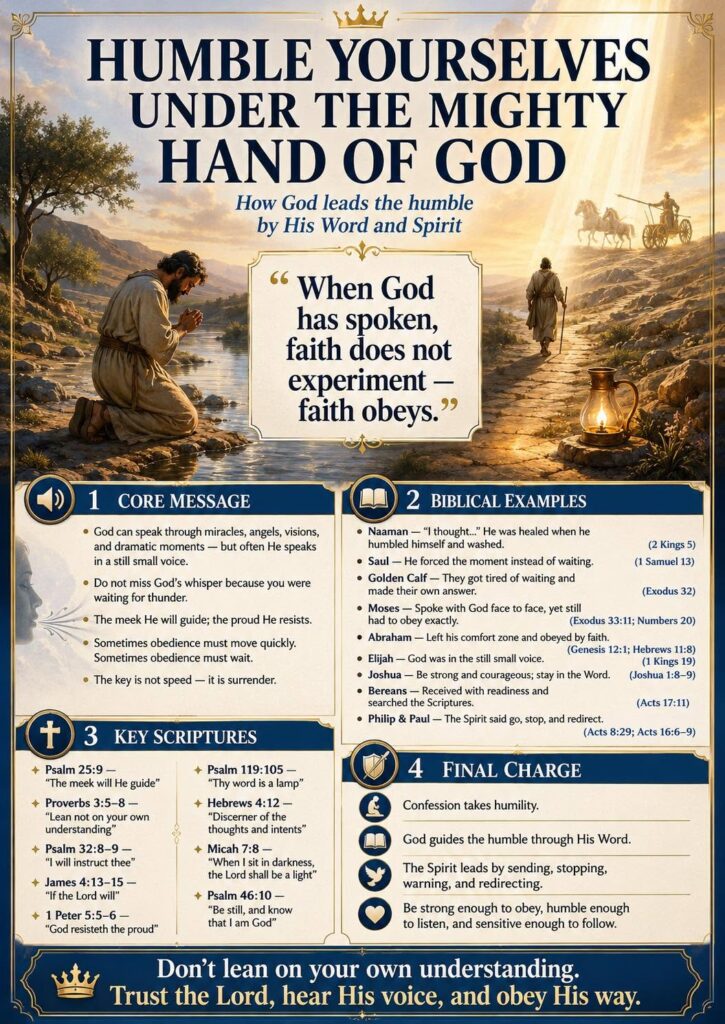
Humble Yourselves Under the Mighty Hand of Elohim
How Elohim Leads the Humble by His Word and Spirit
How do we hear the voice of Elohim? Is it always a sign? Is it always a dramatic direction? Is it always a miracle, an angel, a vision, or fire from heaven? Elohim can speak any way He chooses. He can speak through miracles. He can send angels. He can give dreams, visions, prophetic words, physical signs, and divine appointments. But the danger is when we demand that Elohim speak dramatically before we obey simply.
The story of Naaman gives us a powerful picture. Naaman came to Elisha with an expectation in his mind. In 2 Kings 5:11 / מלכים ב׳ ה׳:י״א, he said, “Behold, I thought, He will surely come out to me, and stand, and call on the name of YHWH his Elohim, and strike his hand over the place, and recover the leper.” Naaman had already imagined the method. He expected Elisha to come out, lift his hand, call on Elohim, and perform a dramatic healing.
But Elisha did not do it the way Naaman expected. He sent a messenger with a simple instruction: go and wash in the Jordan seven times. Naaman was offended because the instruction seemed too simple, too ordinary, and too humbling. He almost missed his miracle because he was attached to his own thought: “I thought…”
This is a serious word for every believer. We are not called to live by trial and error when Elohim has already spoken. We are called to live by obedience. When Elohim gives instruction, faith does not experiment — faith obeys. Naaman was not healed while arguing with the instruction. He was healed when he humbled himself and washed.
The theme is this: when Elohim has spoken, do not take matters into your own hands.
Saul is another example. In 1 Samuel 13 / שמואל א׳ י״ג, Samuel told Saul to wait. But Saul saw the people scattering, the enemy gathering, and Samuel delaying. Under pressure, he said, “Bring hither a burnt offering to me,” and he offered the sacrifice himself. Saul probably thought, “I need to do something.” But the problem was that Elohim had not told him to do that thing. Saul lost the kingdom not because he did nothing, but because he did something Elohim never told him to do.
Naaman had to stop imagining how Elohim should move. Saul had to stop forcing a move when Elohim said wait.
The golden calf shows the same spirit. In Exodus 32 / שמות ל״ב, Moses was on the mountain, and the people said, “As for this Moses… we do not know what has become of him.” They became uncomfortable with waiting. They wanted something visible, immediate, and controllable. So they pressured Aaron and made a calf. The golden calf was born when people got tired of waiting on Elohim and decided to make their own answer.
This is where many of us are challenged. Social media has trained us to think that miracles always look big, glamorous, instant, and public. We see the stage, the lights, the testimony, the luxury, and the success. But we do not see the hidden cost. We do not see the sleepless nights, the red-eye flights, the sacrifice, the pressure, the obedience, the tears, and the private battles.
Sometimes we are misled because we think, “If Elohim is really moving, it must look dramatic.” But Naaman teaches us that the miracle may not come with a hand waving over the leprosy. It may come through a simple instruction: “Go wash.” Elijah teaches us that Elohim is not always in the wind, the earthquake, or the fire. In 1 Kings 19 / מלכים א׳ י״ט, Elijah learned to hear the still small voice. Elohim may speak through thunder, but many times He trains His servants to hear a whisper. If I only obey the dramatic, I may miss the divine.
The Word says in 1 Samuel 3:1 / שמואל א׳ ג׳:א׳ that the word of YHWH was rare in those days, and there was no open vision. But the problem was not that Elohim had nothing to say. The people had become dull in hearing. Then Samuel responded with humility: “Speak, for thy servant heareth” (1 Samuel 3:10 / שמואל א׳ ג׳:י׳). The posture of the heart matters. Elohim speaks to the one who is ready to hear.
That is why humility is essential. James 4:6 / יעקב ד׳:ו׳ and 1 Peter 5:5 / פטרוס א׳ ה׳:ה׳ say, “Elohim resisteth the proud, but giveth grace unto the humble.” This comes from Proverbs 3:34 / משלי ג׳:ל״ד, which says that He gives grace to the lowly. Then 1 Peter 5:6 / פטרוס א׳ ה׳:ו׳ says, “Humble yourselves therefore under the mighty hand of Elohim, that he may exalt you in due time.” Naaman came looking for the prophet’s hand, but his healing came when he humbled himself under the mighty hand of Elohim.
Moses shows us another side. Elohim spoke to Moses in a uniquely direct way. In Exodus 33:11 / שמות ל״ג:י״א, YHWH spoke unto Moses face to face, as a man speaks unto his friend. In Numbers 12:6–8 / במדבר י״ב:ו׳–ח׳, Elohim said that He speaks to prophets in dreams and visions, but with Moses He spoke mouth to mouth. Why Moses? Numbers 12:3 / במדבר י״ב:ג׳ says that Moses was very meek, above all the men on the face of the earth. Psalm 25:9 / תהילים כ״ה:ט׳ says, “The meek will he guide in judgment: and the meek will he teach his way.”
Why does Elohim guide the meek? Because the meek do not argue with the instruction. Meekness is not weakness. Moses stood before Pharaoh, led a nation, and carried authority. But inwardly he was submitted. Still, even Moses had to obey exactly. In Numbers 20 / במדבר כ׳, Elohim told Moses to speak to the rock, but Moses struck the rock. Water came out, but Moses changed the method. The lesson is strong: even the one who speaks with Elohim face to face cannot improve on the instruction of Elohim.
Yeshua also warned us about humility in judgment. In Matthew 7:3 / מתי ז׳:ג׳, He spoke about seeing the speck in a brother’s eye while ignoring the beam in our own eye. When someone says, “He is wasting my time,” humility asks, “Whose time do I think this is?” That does not mean we ignore boundaries or allow abuse. But humility checks the heart before judging the situation. Naaman could have said, “Elisha is wasting my time. He did not even come out.” But the real issue was not Elisha’s behavior; it was Naaman’s pride and expectation.
James 4:13–15 / יעקב ד׳:י״ג–ט״ו warns us not to boast about tomorrow, saying, “Today or tomorrow we will go into such a city… and buy and sell, and get gain.” Instead, we ought to say, “If the Lord will, we shall live, and do this, or that.” Pride says, “This is my time, my plan, my schedule.” Humility says, “If YHWH wills.”
This connects to Psalm 32:5 / תהילים ל״ב:ה׳, where David says, “I acknowledged my sin unto thee, and mine iniquity have I not hid.” Then in Psalm 32:8–9 / תהילים ל״ב:ח׳–ט׳, Elohim says, “I will instruct thee and teach thee in the way which thou shalt go: I will guide thee with mine eye.” Confession comes before instruction. A proud man hides his sin; a humble man confesses and gets guided. Elohim wants to guide us with His eye, not pull us with bit and bridle like a horse or mule.
That is why Psalm 46:10 / תהילים מ״ו:י׳ is so powerful: “Be still, and know that I am Elohim.” In Hebrew: “הַרְפּוּ וּדְעוּ כִּי אָנֹכִי אֱלֹהִים.” Harpu means let go. Release. Stop gripping control. Pride grips. Humility releases.
Elohim guides the humble through His Word. Joshua 1:8 / יהושע א׳:ח׳ says that the book of the law shall not depart out of the mouth, but Joshua must meditate on it day and night. Then Joshua 1:9 / יהושע א׳:ט׳ says, “Be strong and of a good courage.” In Hebrew: “חֲזַק וֶאֱמָץ.” Courage is not doing whatever I feel. Courage is obeying what Elohim said. Joshua did not need to invent a strategy; he needed to stay in the Word.
Psalm 119:105 / תהילים קי״ט:ק״ה says, “Thy word is a lamp unto my feet, and a light unto my path.” Psalm 119:24 / תהילים קי״ט:כ״ד says, “Thy testimonies also are my delight and my counsellors.” The Word becomes our counsel — not pride, not pressure, not social media, not “I thought.” And Hebrews 4:12 / אל העברים ד׳:י״ב says the Word of Elohim is living, powerful, sharper than any two-edged sword, and a discerner of the thoughts and intents of the heart. Naaman had thoughts. Saul had pressure. Israel had fear. Moses had frustration. David had hidden sin. The Word cuts deeper than appearances and reveals pride, impatience, control, fear, and self-will.
There is a time to act and a time for caution. Ecclesiastes 3:1 / קהלת ג׳:א׳ says there is a season and a time for every purpose under heaven. Sometimes obedience must be quick. Abraham heard the call and left his comfort zone. In Genesis 12:1 / בראשית י״ב:א׳, Elohim told him to leave his country, his kindred, and his father’s house, and go to a land He would show him. Hebrews 11:8 / אל העברים י״א:ח׳ says Abraham obeyed and went out, not knowing where he was going. Faith is not always knowing the destination. Sometimes faith is obeying the direction.
Philip also obeyed quickly. In Acts 8:29 / מעשי השליחים ח׳:כ״ט, the Spirit said, “Go near, and join thyself to this chariot.” Philip did not debate; he ran. Sometimes the instruction is practical: pick up the truck, make the call, go now, move quickly. Pride and stubbornness can hide behind the phrase, “I’m still praying about it,” when Elohim has already made the instruction clear.
But sometimes obedience means waiting. Saul should have waited. Israel should have waited. Paul had to be redirected. In Acts 16:6–9 / מעשי השליחים ט״ז:ו׳–ט׳, Paul and his team wanted to preach in Asia, but the Holy Spirit stopped them. Then they tried Bithynia, but the Spirit did not allow them. Then came the Macedonian vision. Courage is not stubbornness. Courage moves when Elohim says move, and humility stops when Elohim says stop.
The Bereans give us balance. Acts 17:11 / מעשי השליחים י״ז:י״א says they received the word with readiness of mind and searched the Scriptures daily to see whether those things were so. They were not rebellious skeptics, but they were not gullible either. Humility receives, and wisdom examines.
Yeshua Himself was led by the Spirit into the wilderness (Luke 4:1 / לוקס ד׳:א׳). Peter was led beyond his old mindset to Cornelius (Acts 10:19–20 / מעשי השליחים י׳:י״ט–כ׳). Barnabas and Saul were set apart by the Holy Spirit (Acts 13:2 / מעשי השליחים י״ג:ב׳). The early Kehilah made decisions saying, “It seemed good to the Holy Spirit, and to us” (Acts 15:28 / מעשי השליחים ט״ו:כ״ח). Agabus warned by the Spirit of famine (Acts 11:28 / מעשי השליחים י״א:כ״ח). Paul was bound in the Spirit toward Jerusalem (Acts 20:22–23 / מעשי השליחים כ׳:כ״ב–כ״ג). And Romans 8:14 / רומים ח׳:י״ד says that as many as are led by the Spirit of Elohim, they are the sons of Elohim.
So the call is clear: we must become more sensitive to the leading of the Holy Spirit. The Holy Spirit sends, stops, warns, redirects, appoints, and strengthens. But the humble heart must be ready to obey.
Do not lean on your own understanding. Proverbs 3:5–8 / משלי ג׳:ה׳–ח׳ says, “Trust in YHWH with all thine heart; and lean not unto thine own understanding. In all thy ways acknowledge him, and he shall direct thy paths.” Naaman’s issue was “I thought.” Proverbs says, “Lean not.” The miracle begins where leaning on our own understanding ends.
So be strong and courageous. Be humble and teachable. Be quick when Elohim says move, and be still when Elohim says wait. Be a believer who hears the Word, searches the Scriptures, confesses sin, receives correction, and follows the Spirit.
When Elohim has spoken, faith does not experiment — faith obeys.